


Executive Summary
Technical information is a key intellectual property. We must manage it efficiently and effectively throughout the enterprise. Customers now explore technical information as much during pre-sales as they do post-sales. This information is no longer limited to the “technical publications” function. Instead, technical details about how products are selected, installed, operated, and serviced are pervasive. They appear in Marketing, Training, and Service functions within the enterprise.
Organizations can significantly improve time-to-market, development costs, support costs, and customer satisfaction. They achieve this by using structured content. Furthermore, they deconstruct information silos. This leads to a single source of truth for technical information. This information is created once and then used in multiple functions.
Introduction
Perspective is an interesting thing. A moon that seems so large rising above the horizon becomes just a small disk once high in the night sky. We all have our own perspective or paradigm of the business world around us. In the technical organization, the Technical Publications department perhaps best personifies this.
Historically, management viewed the Tech Pubs department as a backwater cost center. It served as necessary business aspect to fulfill delivery obligations. They informed customers how to install, operate, and/or maintain purchased equipment. As a cost center, they thoroughly scrutinized investments and kept them to a bare minimum. Other departments hardly knew of their existence. They operated in almost complete autonomy from the “word geeks” endlessly obsessed with manuals. Tech writers also often adopted a victim mentality. Demands were invariably too high, funding always too low, and timelines impossibly tight. While Engineering typically provides product knowledge, they rarely integrate or automate the connection between Engineering and Tech Pubs.
The real challenge lies in recognizing that information flows are worth managing. Managed information flows, in fact, offer a competitive distinction for your business.
This White Paper does not focus on Technical Publications. Instead, it focuses on technical information. It explores how this information flows throughout the organization. It also examines the impact of technical information on customer behavior. We will discuss what we see as the invisible crossroads many companies face regarding their growth and profitability. Many may not even be aware of these crossroads.
We already possess the technology and knowledge to manage and optimize technical information and its flows. These are your key intellectual properties. We can use them to: a) fuel increased revenue through improved customer satisfaction, and b) decrease costs by finding operational efficiencies. The technology is no longer bleeding edge; it has a proven track record. The stumbling block, however, is recognizing that information flows deserve management. Managed information flows offer a competitive distinction for you. In this White Paper, we will show you why and how.
To gain perspective on your future direction, you must understand your starting point. For technical information, the one constant has always been its source: Engineering. Whether drawings, documents, or memos, the organization’s key intellectual property typically originates in Engineering.
While technical manuals derived from their engineering drawings, technical writers usually created them based on their own understanding. There was often little interaction with Engineering.
A New Era
In the pre-word processing era, typewriters created manuals. They pasted Graphics onto the page. This resulted in a very time-consuming process. Other departments, such as Training, Marketing, and Service, faced similar challenges. They primarily interpreted Engineering materials and repurposed them to meet their departmental goals.
This process also created a major challenge when it was time to update and deliver revised information.
The advent of word processors brought a slightly better environment. Content could be manually moved through a ‘copy and paste’ process. This eliminated re-typing information.
However, this paradigm resulted in each department having its own content silo. These silos were disconnected from the source (Engineering) information. They were also disconnected from related departments using the same source information. The result was a dysfunctional organization. It operated with mostly accurate information but suffered from built-in inefficiencies.
The military, aerospace, and publishing markets urgently needed to improve how they created, managed, and delivered large amounts of information. SGML, a highly complex markup language, became the initial mainstream solution for sharing machine-readable, large-scale project documents. While it successfully enabled this type of document exchange, it never gained broad adoption. This was due to its high cost and complexity in both implementation and maintenance. Nevertheless, SGML established the groundwork for subsequent markup languages, including XML and HTML.
As the business world migrated to personal computers, the internet brought a new and faster way to access information. It became clear that the way we curated technical information had to change. Adobe’s PDF™ file format was the response. It presented content independently of application software, hardware, and operating systems. Today, however, it shows its age and has limitations. Other technologies now solve these issues.
This means technical information is now part of the marketing portfolio. Prospects engage in pre-sales due diligence.
The Information Age of the last twenty years has significantly strained the technical information paradigm. A 2017 Lightspeed survey reported that 53% of global respondents use technical product information to learn about a product before buying it. This means technical information is now part of the marketing portfolio. Prospects engage in pre-sales due diligence. Often, inclusion of technical information is required to ship the finished product. Training and Service need the most current information to correctly execute their missions. Products are becoming more complex. Development cycles are typically compressed to shrink time to market. Organizations are pursuing global markets. Customers expect to see content in their language.
Consequently, the technical information associated with a product or service is not only harder to create on time, but it is also pervasive throughout the organization. The old way of manually creating and managing technical information no longer works.
A Changing World
We think of the 1990s as an era of digitization. Processes and work products were developed using discrete, analog means. Marketing pieces (posters, flyers, position papers) were conceived by hand and developed at a printer. Technical Publications departments moved from typewriters to computers. Service and Training created documentation based on product specifications, notes, and materials developed elsewhere.
Today, organizations like Marketing, Service, and Training might all develop their own materials online. However, the files are often not named, managed, or stored in mutually available repositories. This becomes evident on company websites. Customers must guess at a corporate organization chart to find the information they need. Once found, they have no way of knowing if any piece of information is the most relevant. They also cannot tell if they have found everything they need. Buyers find company websites as important as search engines when looking for trustworthy product information.
Forward-thinking companies recognize the waste of multiple repositories, unstructured content, and unassociated workflows. These lead to developing and maintaining disparate information products. They also understand that customer satisfaction with their products, website, and service is under constant pressure to improve.
Addressing these problems no longer requires bleeding-edge technology. Standards-based automation and management models exist and are in use. Computers can therefore do what they do best: automate and streamline tasks. This facilitates and simplifies the management of one of the most important assets to any organization: the information it creates.
Technical Information is the Blood
If Engineering is the ‘brain’ of an organization offering a ‘technical’ product or service, then the technical information associated with that product or service is its blood. Whether used in Marketing, Sales, Service, Training, or ‘Tech Pubs,’ technical information is critical intellectual property. We should both nurture and manage it.
The flow of technical information through the organization is illustrated in the following diagram:
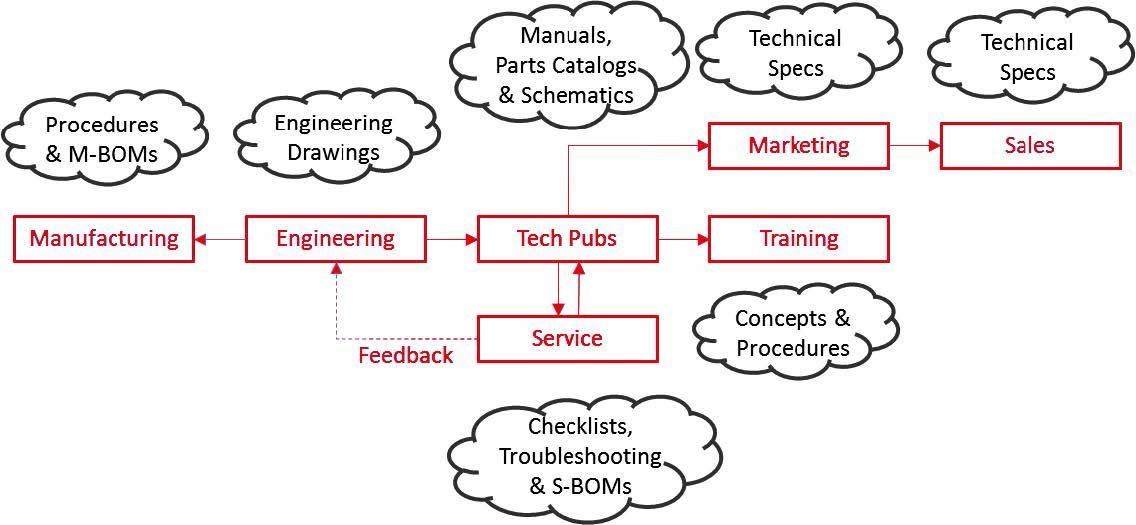
Notice that everything on the right side of “Engineering” is a customer facing function that drives the customer experience.
Relating Technical Information to Customer Service
Good technical product content significantly impacts customer satisfaction. It also affects customers’ willingness to purchase other products from the same brand. In the same Lightspeed survey, 76% of U.S. respondents said product information is essential for good customer service. A similar 73% indicated that quality product information makes them more likely to recommend the brand to others.
And it’s the Customer Experience that Matters
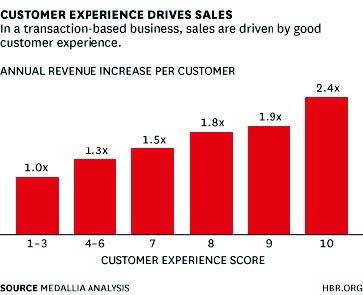
In August 2014, Harvard Business Review (HBR) wanted to explore ways to quantify the impact of good versus poor customer experiences. They then sought to determine the value of delivering them. They found that quantifying the impact of customer experience is possible. Moreover, the effects are huge.
They discovered that after controlling for other factors driving repeat purchases in transaction-based businesses (e.g., how often customers need specific goods and services), those with good customer experiences spent 140% more. This compares to those who had poor experiences.
The Costs of Good Customer Experience
The same HBR report addresses this topic:
“Of course, the rationale we often hear for not investing to deliver a great experience is that the cost is high. Speaking to executives inside these businesses, however, we often hear the opposite. That is: delivering great experiences actually reduces the cost to serve customers from what it was previously. Unhappy customers are expensive — being, for example, more likely to return products or more likely to require support. Systematically solve the source of dissatisfaction, you don’t just make them more likely to return — you reduce the amount they cost you to serve. For example, Sprint has gone on record as suggesting that as part of their focus on improving the customer experience, they’ve managed to reduce their customer care costs by as much as 33%.”
It’s time to stop the philosophical debate about whether investing in your customers’ experience is the right business decision. This is not a question of beliefs. Instead, it’s about your customers’ behavior. Connect the right data, and you can quantify the impact of the difference between delivering a great experience and a poor one. This will demonstrate to everyone in your organization just how significant that impact can be.
1https://hbr.org/2014/08/the-value-of-customer-experience-quantified
Mandates From the Top
In discussions with managers who drive customer experience, we hear a common refrain: Managers are too busy with day-to-day tasks to be strategic.
McKinsey & Co. looked at the consumer decision journey. They found that in many companies, different parts of the organization undertake specific customer-facing activities. These include informational websites, PR, and loyalty programs. Funding is often opaque. Several executives are responsible for each element, but they do not coordinate their work or even communicate. Therefore, these activities must be integrated and given appropriate leadership.
Managers are often so busy keeping up with the daily task to be strategic.
Checklist for Success
Here are tactics that result in profound increases in customer satisfaction and/or cost decreases:
- Implement a “single source of truth” for technical information
- Content silos lead to inefficient operations and inaccurate information. By sourcing content from a single repository, internal users will always access the most current information.
- Reuse appropriate content across the enterprise
- Content reuse means delivering the same information in multiple instances. This applies regardless of the format (paper, PDF, mobile, etc.). Reuse allows for a consistent message using the latest content. It also allows Marketing, Training, Tech Pubs, and Service to use the same core information. This information can be packaged differently and with different peripherals in an automated manner.
- Optimize translation processes
- If you aim to become a more global enterprise, language translation is a critical part of the process. If you already translate content, reducing those costs is likely an ongoing effort. Modular content (think of your content as LEGO™ blocks that can build different deliverables) allows for reuse. Furthermore, it significantly lowers translation costs. This is because only the content ‘blocks’ that have changed are translated. The process can also be automated with minimal human intervention.
- Develop self-service customer service portals with mobile support
- How customers want to be served and how they want to engage with companies has changed considerably in the past decade. The problem is that most service strategies have not followed suit. This hurts companies not just once but twice: through increased operating costs and decreased customer loyalty.
- Embrace customer and field feedback
- Customer service organizations use feedback about their products, services, and organizational processes. This helps them improve the quality of service they deliver. However, companies either inconsistently measure or fail to measure the success of their customers’ cross-channel journeys. This is because different functional organizations often manage channels independently. Without these measurements, they cannot effectively support a customer throughout their service journey.3
2https://www.mckinsey.com/business-functions/marketing-and-sales/our-insights/the-consumer-decision-journey
3Forrester Research “Trends 2016: The Future of Customer Service” January 2016
From Concept to Action
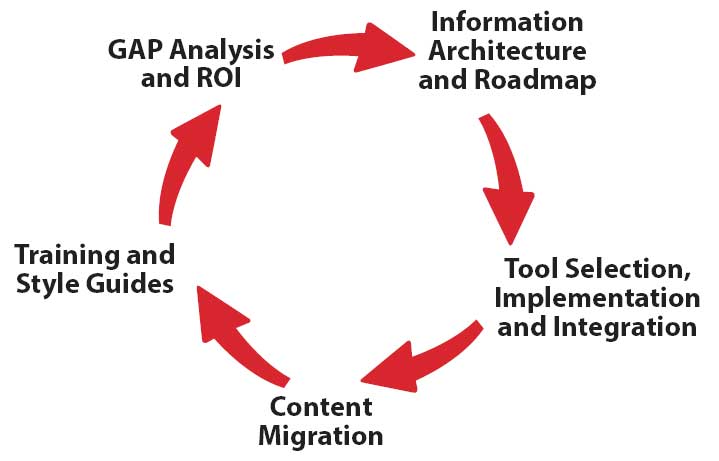
We have worked with technical information for over 45 years across various industries. During this time, we developed a proven process to successfully implement these types of changes. Often, organizations turn to new technology (tools) as a “silver bullet” without doing their homework first. Our approach is different. It is based on understanding and quantifying business requirements. We then develop and implement an architecture that addresses business needs. Finally, we verify that requirements were met. Strong leadership and engaged management are essential to drive the mandate through the enterprise. Therefore, we work with executives, directors, and managers to align a common vision and specific objectives. Being tool provider-agnostic (there are many choices) allows us to implement technology, processes, and skills that address business requirements and constraints. This keeps our priorities aligned with yours.
What About the WOW Stuff?
We see a lot of buzz around futuristic technologies. These include the Internet of Things (IoT), Augmented/Virtual Reality, and ChatBots. While these newer technologies are impressive, and likely part of the future of technical information, they are still – for the most part – on the ‘bleeding edge’ in 2018.
Our approach is to develop your information architecture. This ensures that the framework for these technologies is in place. It will be ready if and when the value proposition aligns with (future) business needs. Structured content forms the foundation of all these futuristic technologies. By ‘designing in’ but not ‘building out,’ you are better prepared for next-generation solutions. This also avoids risking near-term profits.
Structured content is the foundation of all these futuristic technologies.
Next Steps
JANA has committed to technical information for over 45 years. It is our only business. Our team has implemented dozens of technical information environments. We have also trained hundreds of technical writers on their operation. Furthermore, we understand the critical links between Engineering, Tech Pubs, Training, Marketing, and Service.
JANA will take the time to understand your situation and objectives. We will then work with you and your team. Together, we will build and implement a plan. This plan will improve customer satisfaction and time to market (increasing bottom-line revenue). It will also improve operational efficiency (decreasing bottom-line expenses).
If you value a partner that not only talks the talk but walks the walk, JANA is the right answer.
Download JANA White Paper PDF


